
SPECIALIST ENDOCRINE CARE
Adrenal Surgery in Lebanon Specialized Surgical Care for Adrenal Masses & Adrenal Gland Disorders
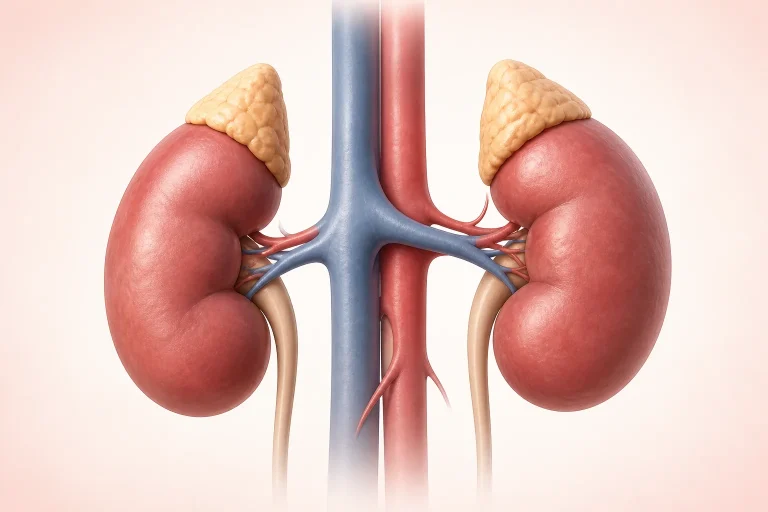
The adrenal glands are located above the kidneys and produce hormones that help regulate blood pressure, metabolism, stress response, and other essential body functions.
Book Your Consultation
An adrenal mass does not always require surgery. Careful evaluation is necessary to determine whether the mass produces excess hormones, has suspicious characteristics, causes symptoms, or requires surgical removal.
Dr. Joseph Gharios provides specialized adrenal surgery in Lebanon, with treatment decisions based on hormonal assessment, imaging findings, the characteristics of the adrenal mass, and evidence-based clinical recommendations.
Understanding Adrenal Masses
An adrenal mass is an abnormal growth found in one of the adrenal glands. Some are discovered incidentally during a CT scan or MRI performed for another medical reason and are therefore known as adrenal incidentalomas.
Many adrenal masses are benign and can be monitored without surgery. Others may require further investigation or treatment depending on their size, appearance, growth, and hormonal activity.
Evaluation aims to answer two important questions:
- Is the adrenal mass producing excess hormones?
- Does the mass have characteristics that require surgical treatment?
The answers help determine whether monitoring, additional testing, or adrenal surgery is the appropriate approach.
Conditions That May Require Adrenal Surgery
Functioning Adrenal Tumors
Some adrenal tumors produce excessive amounts of hormones and can affect different systems throughout the body.
Depending on the hormone involved, patients may develop conditions related to excess cortisol, aldosterone, or catecholamine production.
A complete hormonal evaluation is essential before considering surgery.
Adrenal Adenoma
An adrenal adenoma is usually a benign tumor of the adrenal gland.
Many adrenal adenomas do not cause symptoms and require only appropriate monitoring. Surgery may be considered when an adenoma produces excess hormones or meets other clinical criteria for removal.
Pheochromocytoma
A pheochromocytoma is a tumor that can produce excessive catecholamines, hormones involved in regulating heart rate and blood pressure.
Careful diagnosis and appropriate medical preparation before surgery are particularly important for patients with this condition.
Suspicious Adrenal Masses
Certain adrenal masses may have imaging or clinical characteristics that raise concern for malignancy.
Treatment planning considers factors such as:
- Size of the adrenal mass
- Imaging characteristics
- Hormonal activity
- Changes in size over time
- Symptoms
- Overall clinical context
When Is Adrenal Surgery Recommended?
Not every adrenal mass needs to be removed.
Adrenal surgery may be considered when:
- The mass produces excess hormones
- Imaging findings are suspicious
- There is concern for malignancy
- The mass increases significantly in size
- The lesion causes clinically relevant symptoms
- Other established surgical indications are present
The decision should be made after comprehensive evaluation rather than based on the presence of an adrenal mass alone.
Evaluation Before Adrenal Surgery
Before deciding on surgery, patients generally require a detailed assessment to understand the nature and function of the adrenal mass.
Evaluation may include:
- Medical history and clinical examination
- Hormonal blood and/or urine tests
- CT scan
- MRI when indicated
- Review of previous imaging to assess changes over time
- Multidisciplinary evaluation when appropriate
Hormonal testing is particularly important because identifying a functioning adrenal tumor can affect both the decision to operate and preparation for surgery.
Adrenalectomy
An adrenalectomy is the surgical removal of an adrenal gland.
The surgical technique is selected according to the size and characteristics of the tumor, its location, the possibility of malignancy, the patient's previous surgical history, and other individual factors.
Laparoscopic Adrenalectomy
For appropriately selected adrenal conditions, laparoscopic adrenalectomy allows the gland to be removed using small incisions and specialized surgical instruments.
Potential advantages of a minimally invasive approach may include:
- Smaller incisions
- Reduced postoperative discomfort
- Shorter hospital stay
- Faster return to daily activities
Suitability for laparoscopic surgery must be determined individually.
Open Adrenal Surgery
An open approach may be necessary for selected large or complex adrenal tumors, particularly when there is concern about local invasion or malignancy.
The priority is selecting the surgical approach that provides appropriate and safe treatment for the individual condition.
Preparing for Surgery
Preparation varies according to the type of adrenal disorder.
For hormonally active adrenal tumors, medical management before surgery may be required to control hormone-related effects and reduce perioperative risks.
This may involve collaboration with endocrinologists, anesthesiologists, radiologists, and other specialists.
Multidisciplinary planning is particularly important for complex adrenal conditions.
Adrenal Surgery & Minimally Invasive Techniques
When clinically appropriate, minimally invasive techniques can be used for adrenal surgery to reduce surgical trauma while maintaining the objectives of the procedure.
However, minimally invasive surgery is not automatically the best approach for every adrenal mass. The choice between laparoscopic and open surgery depends on the diagnosis, anatomy, tumor characteristics, and patient-specific factors.
References
- European Society of Endocrinology (ESE)
- American Association of Endocrine Surgeons (AAES)
- European Society of Endocrine Surgeons (ESES)
- Evidence-based clinical guidelines for adrenal tumors and adrenal incidentalomas
Frequently Asked Questions
Does every adrenal mass require surgery?
No. Many adrenal masses are benign, non-functioning, and can be monitored. Surgery is considered according to hormonal activity, imaging characteristics, growth, symptoms, and other clinical factors.
What is an adrenal incidentaloma?
An adrenal incidentaloma is an adrenal mass discovered unexpectedly during imaging performed for another reason. Further evaluation may be needed to determine whether it produces hormones or has concerning characteristics.
How do doctors determine whether an adrenal mass is functioning?
Hormonal blood and/or urine tests can help determine whether the adrenal gland is producing excessive hormones. The specific tests depend on the patient's clinical situation.
What is adrenalectomy?
Adrenalectomy is the surgical removal of an adrenal gland. It may be performed using a minimally invasive or open approach depending on the condition.
Can adrenal surgery be performed laparoscopically?
Yes. Laparoscopic adrenalectomy may be appropriate for selected patients. The decision depends on the size and characteristics of the mass, suspected diagnosis, anatomy, and other clinical factors.
Can you live normally with one adrenal gland?
When the remaining adrenal gland is healthy and functioning normally, it can generally provide the hormones the body needs. Individual hormonal follow-up may still be required depending on the underlying condition.
What happens before surgery for a functioning adrenal tumor?
Some functioning tumors require specific medical preparation before surgery to control hormone-related effects. The exact preparation depends on the type of hormone being produced.