Dr. Joseph Gharios
- Educational
- October 20, 2026
- 6 MINS READ
A feeling of tightness in the throat, difficulty swallowing, or a choking sensation can have several possible causes. But what if the problem is not coming from the lungs or throat itself?
In some patients, these symptoms may be caused by an enlarged thyroid nodule pressing against nearby structures.
Understanding thyroid nodule symptoms and thyroid nodule causes is important because not every thyroid nodule produces obvious signs, and not every symptomatic nodule requires conventional surgery.
A real patient case treated by Dr. Joseph Gharios illustrates how identifying the underlying cause can change the treatment approach.
What Are the Common Thyroid Nodule Symptoms?
A thyroid nodule is a lump that develops within the thyroid gland, located at the front of the neck.
Most thyroid nodules are benign, and many do not cause noticeable symptoms. However, larger nodules can sometimes press against surrounding structures.
Possible thyroid nodule symptoms include:
- Difficulty swallowing
- A sensation of pressure or tightness in the neck
- A choking or constricting sensation
- Breathing discomfort, particularly with certain positions or activities
- Visible swelling at the front of the neck
- Changes in voice in some cases
These symptoms are not specific to thyroid disease. Proper evaluation is necessary to identify their cause.
What Causes Thyroid Nodules?
Patients often ask about thyroid nodule causes, particularly when a nodule is discovered unexpectedly.
Thyroid nodules may develop for different reasons, including:
- Overgrowth of normal thyroid tissue
- Fluid-filled thyroid cysts
- Multinodular goiter
- Thyroid inflammation
- Iodine deficiency in some populations
A smaller proportion of thyroid nodules may be malignant, which is why appropriate evaluation is essential before deciding on treatment.
A Real Patient Case: A 36-Year-Old Woman With a Choking Sensation
A 36-year-old woman had been experiencing recurring episodes of difficulty swallowing and a sensation of choking.
She noticed that the discomfort became particularly noticeable during stressful moments or when climbing stairs.
At times, she felt as though something was tightening around her throat, making her breathing uncomfortable.
Searching for an explanation, she consulted different specialists, including a pulmonologist and an ENT physician.
However, the cause of her symptoms remained unclear.
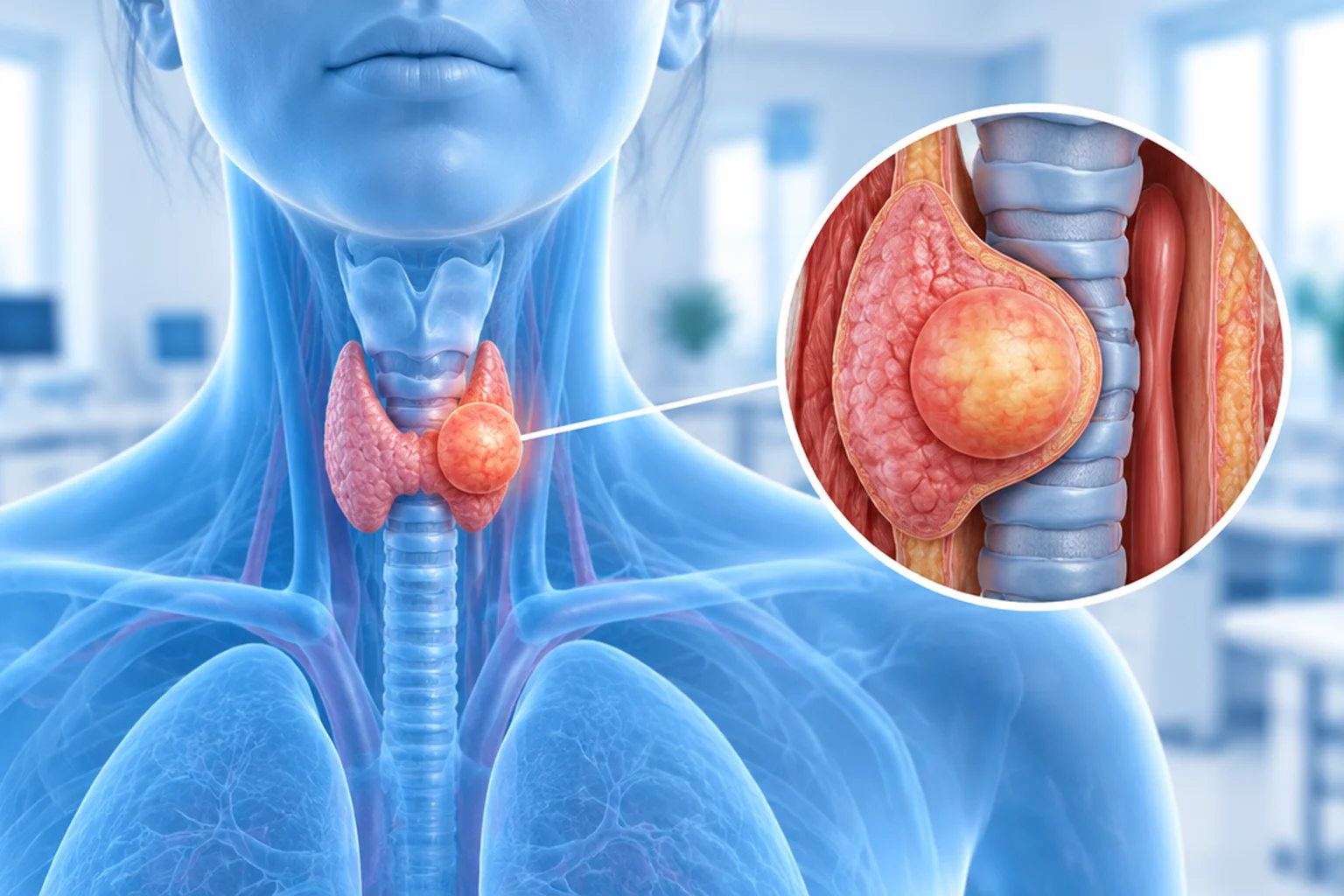
When she eventually consulted Dr. Joseph Gharios, a thyroid ultrasound revealed an important finding: a large thyroid nodule.
The nodule was pressing against nearby structures, including the trachea (windpipe) and esophagus (food pipe).
This helped explain why she had been experiencing both breathing discomfort and intermittent difficulty swallowing.
The problem was not simply a sensation of stress. There was a physical structure creating pressure in her neck.
Why the Biopsy Was Essential Before Treatment
Finding a large thyroid nodule does not automatically mean it is benign.
Before deciding on treatment, Dr. Gharios performed a biopsy to assess the nodule.
The results confirmed that it was benign, allowing him to consider radiofrequency ablation (RFA) as a treatment option.
This was a crucial step because RFA is generally intended for appropriately selected benign thyroid nodules. Suspicious nodules require further evaluation and may need a different treatment approach.
Patients can learn more about this process through Dr. Gharios’s benign thyroid nodule treatment information.
Treating the Nodule Without Conventional Surgery: Radiofrequency Ablation
Instead of removing part or all of the thyroid gland, Dr. Gharios treated the patient using radiofrequency ablation (RFA).
RFA is a minimally invasive technique that uses controlled thermal energy to treat the targeted nodule.
Under ultrasound guidance, a specialized electrode is introduced into the nodule. The energy heats the targeted tissue, allowing the nodule to gradually decrease in size over the following weeks and months.
The objective is to reduce the pressure caused by the nodule while preserving surrounding healthy thyroid tissue.
In this patient’s case, RFA was performed without conventional thyroid removal surgery.
Following treatment, Dr. Gharios reported that her symptoms improved significantly.
For a patient who had spent time searching for the cause of her discomfort, identifying the thyroid nodule and treating it appropriately made an important difference.
Does Every Thyroid Nodule Require Treatment?
No. Many thyroid nodules are small, benign, and do not cause symptoms. These may only require monitoring.
Treatment may be considered when a nodule:
- Causes difficulty swallowing or pressure symptoms
- Produces visible neck swelling
- Continues to grow
- Creates significant discomfort
- Has suspicious characteristics requiring further investigation
Depending on the findings, treatment may involve monitoring, RFA, or surgery.
As part of his endocrine surgery practice, Dr. Gharios evaluates thyroid conditions to determine which approach is appropriate for each patient.
Frequently Asked Questions
Can a thyroid nodule cause difficulty swallowing?
Yes. A sufficiently large thyroid nodule can press against the esophagus and cause swallowing discomfort or difficulty.
Can a thyroid nodule make breathing difficult?
In some cases, a large nodule may compress or displace the trachea, causing breathing discomfort. New or worsening breathing difficulty requires prompt medical assessment.
Are thyroid nodules always cancerous?
No. Most thyroid nodules are benign. However, ultrasound evaluation and biopsy when indicated help determine whether further investigation or treatment is needed.
Can a thyroid nodule be treated without surgery?
Yes. Selected benign thyroid nodules may be treated using radiofrequency ablation, which reduces nodule volume without surgically removing the thyroid gland.
Does RFA remove the thyroid nodule immediately?
No. The treated nodule generally decreases in size gradually. Follow-up ultrasound is important to assess the response.
The Lesson From This Case: Look Beyond the Symptoms
This patient’s experience highlights an important message: persistent swallowing difficulties, neck pressure, or choking sensations should not automatically be attributed to stress.
Although these symptoms can have several causes, thyroid nodules should be considered when clinically appropriate.
In this case, an ultrasound identified a large nodule pressing against the trachea and esophagus. A biopsy confirmed that it was benign, and radiofrequency ablation provided a minimally invasive treatment option.
The goal is not to treat every thyroid nodule, but to understand which nodules are causing symptoms, which require investigation, and which can benefit from treatment.
If you are experiencing persistent neck pressure, difficulty swallowing, or have been diagnosed with a thyroid nodule, an individualized evaluation can help determine whether monitoring, RFA, or surgery is appropriate. You can book a consultation with Dr. Joseph Gharios at Hôtel-Dieu de France Hospital in Beirut.
References
- American Thyroid Association (ATA) — guidance on thyroid nodules and their evaluation
- European Thyroid Association (ETA) — clinical guidance on thyroid nodule management and image-guided ablation
- International consensus recommendations on radiofrequency ablation for benign thyroid nodules
GET IN TOUCH
Book Your Consultation
Consultations are available at Hôtel-Dieu de France Hospital in Beirut.